Consistent AI Characters: How to Keep the Same Character Across Images & Video (2026)
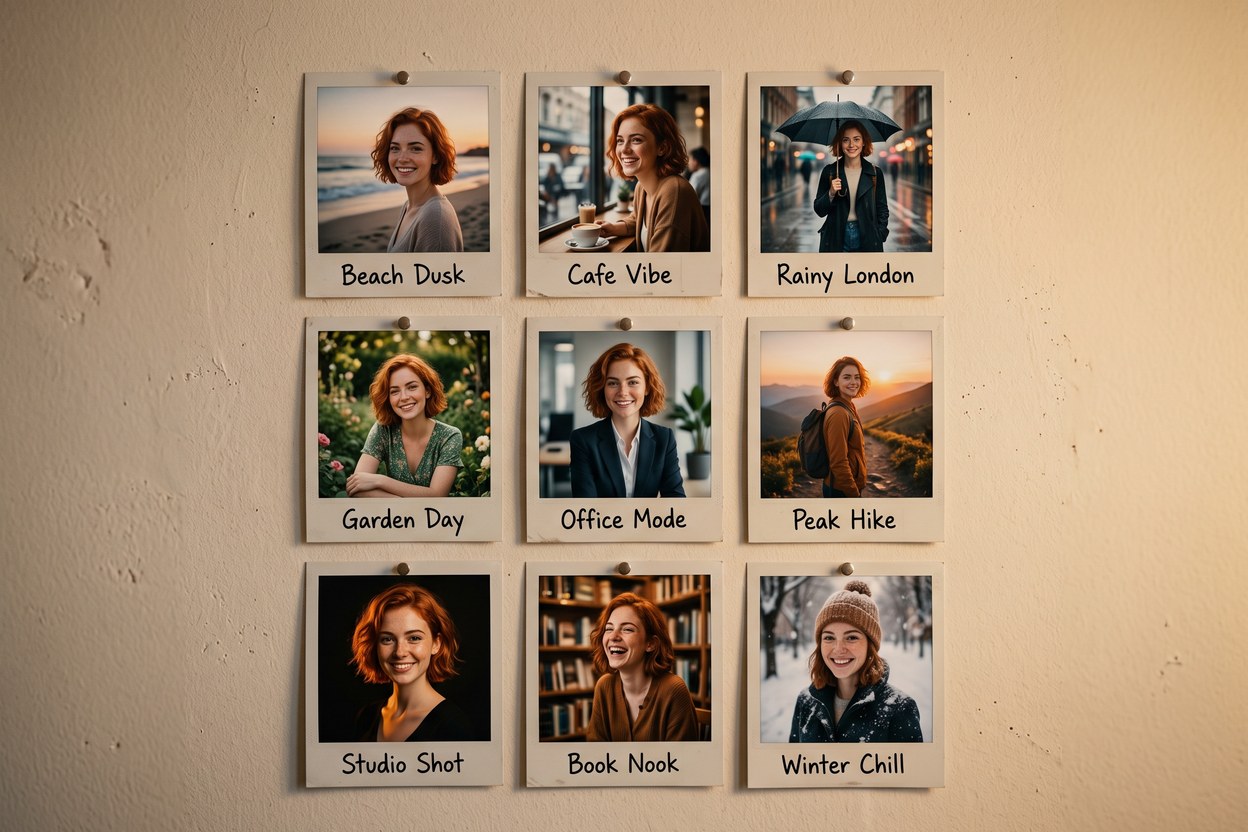
A consistent AI character is a generated person whose face, features and identity stay recognisably the same across every image and video you create of them. It sounds like a basic feature, and it is in fact the single hardest everyday problem in AI content: every generation samples the model fresh, so "the same woman, now on a beach" is a request the technology is architecturally inclined to ignore. This guide covers the three methods that actually deliver character consistency — prompt tricks, reference-image engines and training a dedicated model — with what each costs and an honest account of when each one is the wrong choice.
Why character consistency is hard at all
An image model has no memory. Ask it twice for "a woman with copper hair and freckles" and you get two different women who both fit the description — because the description is all the model has. Consistency means giving the model something stronger than words to anchor to: a reference image it must preserve, or weights that were actually trained on the character. Everything that works is a variation on those two ideas.
Method 1: Prompt tricks and repeated descriptions
The zero-cost approach: write one very specific description — "woman in her 30s, copper bob, green eyes, dusting of freckles, small scar on left eyebrow" — and reuse it verbatim in every prompt. Within a single model and session this gets you characters that are similar, sometimes convincingly so for stylised or illustrated work where viewers forgive drift. For photoreal people it breaks down fast: faces are high-dimensional, and a sentence constrains almost none of it. Use prompt tricks for a quick storyboard or a cartoon mascot — not for a campaign where the same face must survive ten images.
Method 2: Reference-image engines
The middle path: give the model a picture of the character and ask it to preserve that face. This is genuinely good now. In Hermosso's Create studio, the Ideogram Character engine (100 credits per image) is built exactly for this — it requires a reference image and holds identity through pose, outfit and setting changes. Recreate (50 credits) does a related job: it copies a whole reference scene and drops your character into it. For video, Kling Elements (450 credits per clip) accepts up to four reference images and keeps the subject consistent through the motion.
Reference engines shine when you have one strong image of the character — often one you generated once and liked. Their limit is the reference itself: everything downstream is anchored to that single angle and lighting, and consistency degrades the further the request moves from the reference's pose.
Method 3: Train a dedicated model (the strongest option)
The method the industry settled on for serious work is LoRA-style fine-tuning: train a small model on the character, so the identity lives in the weights instead of the prompt. This is what Hermosso's AI Persona is — you upload 10–20 photos of a person (yourself, or someone whose consent you have), a private model trains in about two minutes for 2,000 credits, and from then on every generation is that person: across 67 curated photoshoot packs, free-form prompts, and any style, at 50 credits per photo. Likeness holds across an entire campaign rather than drifting between generations, because the character is baked in, not described.
Plans cap how many trained models you keep — 1 persona on Starter ($9/month), 3 on Pro ($29/month), 10 on Studio ($79/month) — which is what separates a solo creator from an agency running a cast of characters. The model is private to your account, never used to train anyone else's, and deletable anytime.
The three methods compared
| Method | Consistency strength | Cost | Best for |
|---|---|---|---|
| Prompt tricks (repeated description) | Weak — similar, not the same | Just the generation (50–100 credits per image) | Stylised art, storyboards, one-off mascots |
| Reference-image engines (Ideogram Character, Kling Elements) | Good — anchored to one source image | 100 credits per image; 450 credits per video clip | A character you have one great picture of; short series |
| Trained model (AI Persona) | Strongest — identity lives in the weights | 2,000 credits to train, then 50 credits per photo | Campaigns, personal brands, any long-running character |
Consistent characters in video
Video adds a second dimension — the character must hold still while moving — and the reliable workflow is image-first: generate the character as a still (a trained persona is ideal, a strong reference works), then animate that frame with Photo to Video on one of the 18 video engines. Starting from a consistent still beats asking a video model to invent the person and the motion at once. For multi-reference video there is Kling Elements (up to four reference images), and for the specific job of a consistent AI creator fronting an ad, the UGC studio generates the scenes around one persistent character automatically. Per-clip prices for every engine are public in AI video credits, explained.
When LoRA-style training beats prompt tricks — and when it doesn't
Being precise about this saves money in both directions:
- Training wins when the character recurs. Ten images or a hundred, over weeks, in varied settings — the per-photo cost (50 credits) and the consistency both beat re-prompting and hoping.
- Training wins for real people. If the character is you, or a consenting teammate, 10–20 real photos train a likeness no prompt can approximate. Our step-by-step guide to AI photos of yourself covers the input set that gets the best result.
- Prompt tricks win for one-offs. A single stylised image for a slide deck does not justify a trained model.
- Prompt tricks win when you have no source photos. A fictional character you can't photograph starts as a prompt; once one generation looks right, promote it to a reference image (method 2) rather than training.
- Neither is the answer for style-only consistency. If what must stay constant is the look — palette, grade, mood — rather than a person, that's what Moodboards are for: a reference board distilled into a written Style DNA you can apply to any generation.
When persona training is NOT the right choice
- Without consent. A persona is trained from real photos of a real person — it exists for you and people who agreed to it. It is not a tool for recreating someone else's likeness, and that use is exactly what the product refuses.
- For purely fictional casts. A character that exists only as one generated image is better served by reference-image engines than by training on synthetic photos of itself.
- When you need frame-level video control. Personas give you a consistent face in generated video; they don't give you a VFX timeline. If the deliverable is choreographed motion, the pro video tools do that part better.
- Consistency is not identity freeze. A trained persona holds the face; outfit, hair and styling still follow the prompt or pack — which is the point. If you need pixel-identical repetition, generate once and edit that image.
What it costs, in one place
Training a persona is 2,000 credits once; each photo after that is 50 credits; reference-engine images run 50–100 credits and video clips 250–2,400 credits depending on engine. New accounts get 750 free credits — enough to test the instant engines and a reference workflow before training anything — and plans start at $9/month for 5,000 credits, billed monthly, with credits that never expire. Full details on the pricing page.
Try it on your own photos
Upload a few selfies, and Hermosso trains a private AI model of you — then generates studio-quality photos in any style. Your first credits are free.
Create your AI photos →Frequently asked questions
What is character consistency in AI generation?
Character consistency means a generated person keeps the same recognisable face and identity across every image and video you create of them. It is difficult because image models have no memory and sample fresh each generation, so consistency requires anchoring the model to a reference image or training a dedicated model on the character.
How do I keep the same AI character in every image?
The strongest method is training a dedicated model: upload 10–20 photos to Hermosso's AI Persona, and the private model (2,000 credits, about two minutes to train) reproduces that identity across every pack and prompt at 50 credits per photo. Lighter options are reusing one very specific prompt description, or anchoring each generation to a reference image with an engine like Ideogram Character.
Is training a model better than prompting for character consistency?
For a character that recurs across many images, yes — a trained model holds identity in its weights, while a repeated prompt only describes it and drifts. Prompting is the better choice for one-off images, stylised art, or a fictional character you only have a single generated picture of.
How much does it cost to create a consistent AI character?
On Hermosso, training an AI Persona costs 2,000 credits once and each generated photo costs 50 credits; reference-image generation runs 50–100 credits per image. New accounts get 750 free credits, and plans start at $9/month for 5,000 credits.
Can I keep a character consistent across AI video?
Yes — generate the character as a still image first (a trained persona is ideal), then animate that frame with an image-to-video engine, which holds the face while adding motion. For multi-reference video, Kling Elements accepts up to four reference images at 450 credits per clip.
Can I create a consistent fictional character that isn't a real person?
Yes, but the route differs: generate the character once with a detailed prompt, pick the best result, and use it as a reference image for every later generation (Ideogram Character is built for this). Persona training is designed for real, consenting people you have 10–20 genuine photos of.
Do I own the images of my AI character?
Images you generate on Hermosso are yours; full commercial usage rights are included on the Pro ($29/month) and Studio ($79/month) plans, while Starter covers personal use. Your trained persona is private to your account and deletable anytime.