AI Action Figure Trend: Turn Yourself Into a Toy
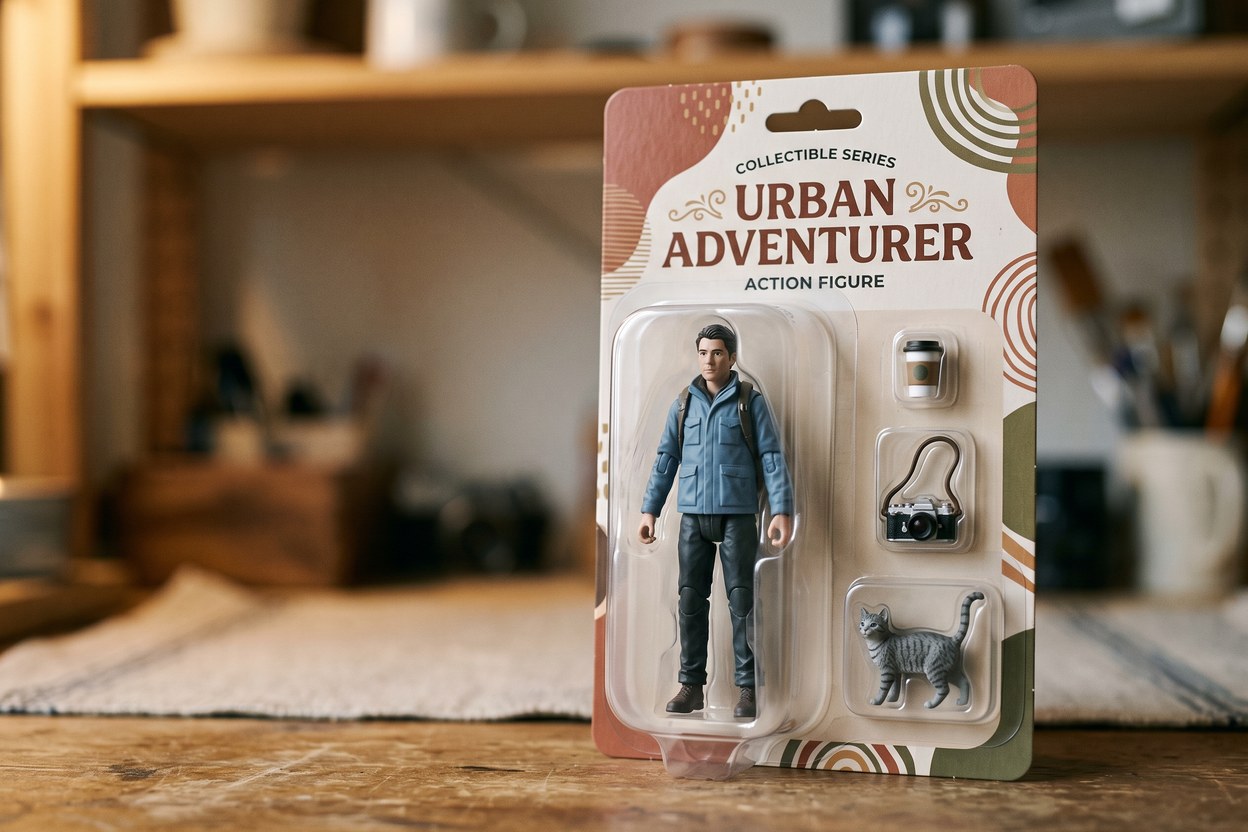
The action figure trend is the most viral AI image format of 2026. People are turning themselves, their friends, their pets and their colleagues into collectible toys — moulded plastic figure, blister pack, cardboard backer, little plastic accessories, a fake brand logo in the corner. It broke out early in the year and, unusually for a format this saturated, has kept running across TikTok, Reels and Pinterest ever since rather than burning out in a fortnight.
Most guides hand you a one-line prompt and leave you with something that looks like a cartoon of a person. The difference between a scroll-past and a share is one specific thing, and it is not the figure.
The packaging is the trend
A stylised plastic-looking person is just a 3D render. What makes the format read instantly as a toy is the retail context around it:
- The blister pack — a clear vacuum-formed plastic bubble, with visible edges and a highlight running down the curve.
- The cardboard backer — printed card behind the bubble, usually with a bold colour block, a logo, and a name plate along the bottom.
- Accessories in their own compartments — a laptop, a coffee cup, a camera, a tiny dog. These are the joke. They are how the figure says something about the person.
- Fake branding and collector furniture — a series name, "Collector Edition", an age rating, a barcode.
Get those four right and even a mediocre figure reads correctly. Get the figure perfect with no packaging and it reads as a Pixar screenshot.
The prompt, piece by piece
Build the prompt in the order the eye reads the image. A useful skeleton:
- Format first: "A collectible action figure in its original blister packaging, photographed straight on."
- The figure: "glossy moulded plastic, visible seam lines, slightly oversized head, matte painted details".
- Wardrobe and pose: describe what the person actually wears. Specific beats generic — "charcoal overshirt, rolled sleeves, arms at sides, neutral expression".
- Accessories: "beside the figure in moulded compartments: an espresso cup, a film camera, a tiny grey cat".
- The card: "printed cardboard backer in deep teal, large title text at the top, name plate along the bottom, small barcode".
- The light: "studio product photography, soft key light from the left, gentle specular highlight across the plastic bubble".
Then iterate on one variable at a time. Changing six things between runs tells you nothing about which change helped.
Putting your own face on it
The generic version is a stranger holding your job title. The version people actually share looks like you, and there are two routes to that.
The quick one: upload a photo you like to Recreate along with the packaging description, and let it rebuild the scene with your likeness in it. Good for a single image, no setup.
The consistent one: train an AI Persona on 10–20 selfies — about two minutes — and then generate as many figure variants as you want with the same face every time. That matters if you are making a set: a whole team as a toy line only works if everyone is recognisable. The step-by-step guide covers the training side.
Where it goes wrong, and the fix
- The text is garbled. Most image models still mangle small print. Ask for fewer words, larger — a short series name and a name plate, not a paragraph of fake legal text. Models with strong typography handle this best.
- The face drifts. A prompt alone will not hold a likeness across a set. That is what a trained persona is for.
- The packaging looks painted on. Ask explicitly for the plastic bubble's edge and a highlight along it; without that the bubble flattens into the card.
- It looks like a 3D render, not a photo of a toy. Add the camera, not just the subject: "product photograph, shallow depth of field, slight reflection on the plastic".
- The accessories float. Say "in moulded compartments" or "held in a plastic tray" so they sit somewhere physical.
Variations worth trying
- Chibi. Exaggerated head, tiny body, big glossy eyes. Reads younger and softer, and travels further on Pinterest.
- Vintage toy line. Ask for faded card, 1980s print registration slightly off, worn corners. It lands in nostalgia territory, which is having a very good year — see our piece on the 2016 nostalgia trend.
- Blind box. The figure plus a small illustrated box and a "1 of 12" label.
- Team sets. The same card design, one figure per colleague, one accessory each that captures what they actually do. This is the version that gets shared internally and then externally.
Make it move
A still figure is the trend; a rotating one is a scroll-stopper. Run the finished image through Photo to Video with a slow orbit or a gentle push-in and you have a clip for Reels without filming anything. Subtle beats dramatic here — a toy that lurches looks like a glitch, a toy that turns slowly looks like a product ad.
Try it on your own photos
Upload a few selfies, and Hermosso trains a private AI model of you — then generates studio-quality photos in any style. Your first credits are free.
Create your AI photos →Frequently asked questions
What is the AI action figure trend?
A viral AI image format where a person is rendered as a collectible plastic toy inside retail packaging — a blister pack on a printed cardboard backer, with moulded accessories and fake collector branding. It broke out early in 2026 and has stayed in circulation across TikTok, Reels and Pinterest since.
What is the most important part of the action figure prompt?
The packaging, not the figure. A stylised plastic person on its own reads as a 3D render; the blister bubble, printed cardboard backer, accessories in moulded compartments and collector-style branding are what make it read instantly as a toy.
How do I make an action figure that actually looks like me?
Train an AI Persona on 10–20 selfies, which takes about two minutes, then generate figure variants from it — the likeness stays consistent across every image, which matters if you are making a set. For a one-off, upload a photo to Recreate instead and describe the packaging around it.
Why is the text on my action figure packaging garbled?
Small text is still the weakest part of most image models. Ask for fewer words at a larger size — a short series name and a name plate rather than paragraphs of fake packaging copy — and pick a model with strong typography handling.
Can I turn the action figure image into a video?
Yes. Run the finished image through Photo to Video with a slow orbit or push-in. Keep the motion subtle: a toy that turns gently reads as a product ad, while anything faster reads as a glitch.